This map shows you which NYC restaurants are owned by private equity
For many consumers, “private equity” has become a four-letter word. Private equity firms have acquired the unpopular reputation of purchasing food establishments that then notoriously decline in quality, as new owners cut costs in search of new avenues to profit. They’ve also been criticized for…
For many consumers, “private equity” has become a four-letter word. Private equity firms have acquired the unpopular reputation of purchasing food establishments that then notoriously decline in quality, as new owners cut costs in search of new avenues to profit. They’ve also been criticized for displacing mom-and-pop shops in the process.
But beyond stereotypical signs of private equity-backing—sudden spikes in new franchise locations and sleek, minimalist branding, to name a few—consumers are often left guessing at businesses’ ownership. That’s especially true in metropolises like New York City, where grabbing a bite means choosing from a whopping 31,000 food establishments.
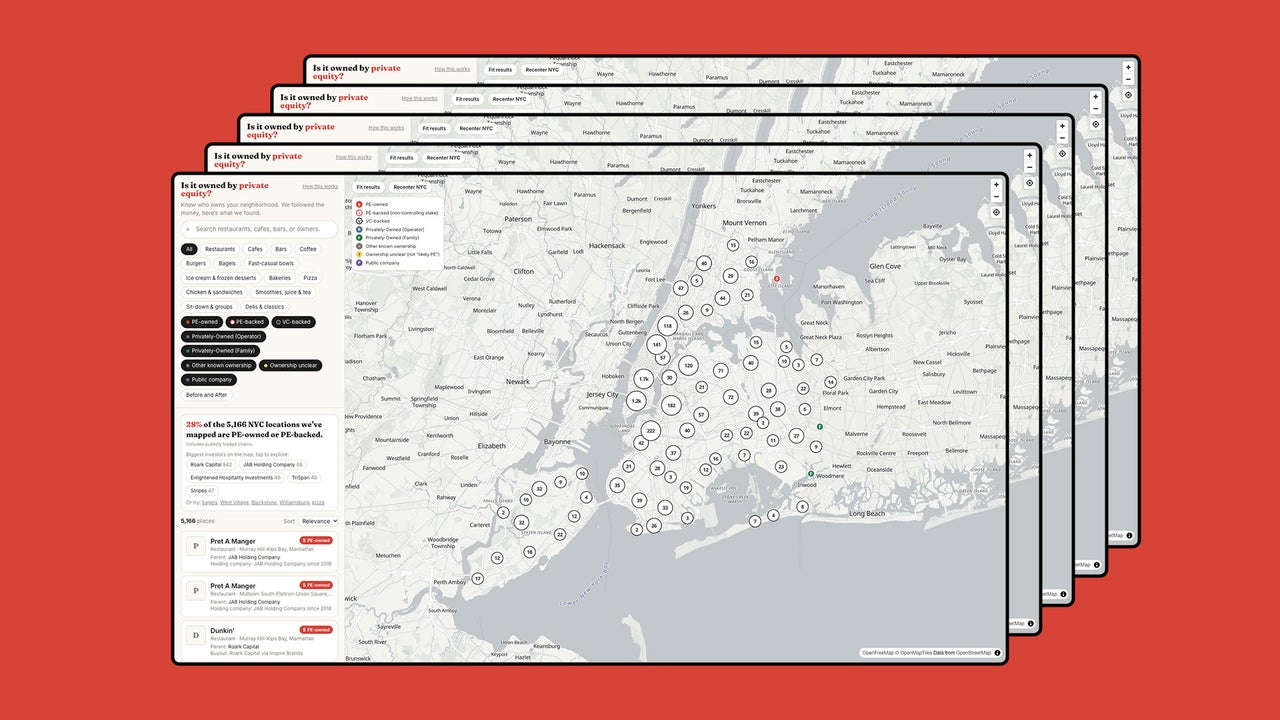
That’s where a trending new website steps in. On isitownedbyprivateequity.com, users can find the answers to the site’s titular question. Via an interactive map of New York City, potential customers can zoom in on any bar, restaurant, or cafe and learn if it’s owned or backed by private equity or venture capital; if it’s public; or if it’s privately owned.
How the site works
The site was created by Davie Liebowitz, known on social media as DeFi Dave, who got the idea from a common complaint he’d seen on the internet.
“What initially inspired me to create it was walking around Manhattan on the weekends and seeing all the lines for different restaurants,” Liebowitz tells Fast Company via social media. “Then I would go online and see the discourse around private equity blaming them for the lines and decrease in quality.”
He went on to create the site with Grok Bot and Cursor in a single day (an experience he described as “psychedelic” in a follow-up post), then shared it on social media. Liebowitz’s X post announcing the site has since garnered more than 178,000 views.
So far, the site has info on just over 5,000 NYC eateries and is growing fast, with 1,320 of those being added in the day since the site’s launch. Of the currently tracked restaurants, bars, and cafes, 28% are owned or backed by private equity, with firm Roark Capital alone accounting for 842 of them. (Nearly all of those are Dunkin’ Donuts and Subway locations—Roark acquired the former in 2020 and the latter in 2024.)
Clicking on a business opens a window with tons of info, including its ownership status, nearby privately owned alternatives, and a scorecard for its neighborhood showing what share of food spots in that area are owned or backed by private equity. According to the site, that data all comes from investor and parent-company portfolio pages, as well as from Wikipedia articles that cite primary sources.
The story beyond private equity
Liebowitz emphasizes that being a private or family-owned business doesn’t automatically correlate with quality.
In another post on X, he took aim at Black Seed Bagels—a chain with sleek, clean branding that fits right in with the private equity crowd, but is actually privately owned. According to Liebowitz, that didn’t stop the bagel shop from skimping on the lox on his sandwich, much to his chagrin.
His map accounts for stereotype-defying establishments with its “before vs. after the deal” window. For private equity-owned or -backed businesses with enough data, the site shows how their quality has changed over time, based on their American Customer Satisfaction Index (ACSI) scores.
For example, Panera Bread has dropped by four points on the ACSI since its 2017 acquisition by JAB Holding Company, while Subway gained five points since being bought by Roark.
Rather than passing hard judgment on “good” or “bad” places to eat, Liebowitz says he hopes his site can simply help consumers be better informed about where their money is going.
“I believe more transparency is always good, especially when it comes to where people decide to spend their money and what businesses to support,” he says. “In addition, I hope people use the site to be more objective about restaurants they patronize.”
Looking ahead, Liebowitz plans to expand the site to cover cities including San Francisco and Los Angeles, as well as let users submit their own information about businesses to build on the site’s existing data. He also hopes to create maps for industries other than food service that are often targeted by private equity firms, including nursing homes, real estate, healthcare, and dentistry.
Originally published by fastcompany.com. Syndicated material does not necessarily reflect the views of Glamour Canada.