How to Get Hair Dye Out of Clothes. 4 Ways That Work.
Hair dye on your shirt or towel? Here's the fix, and why the real clock ticking is the dye's own chemistry, not your laundry routine.
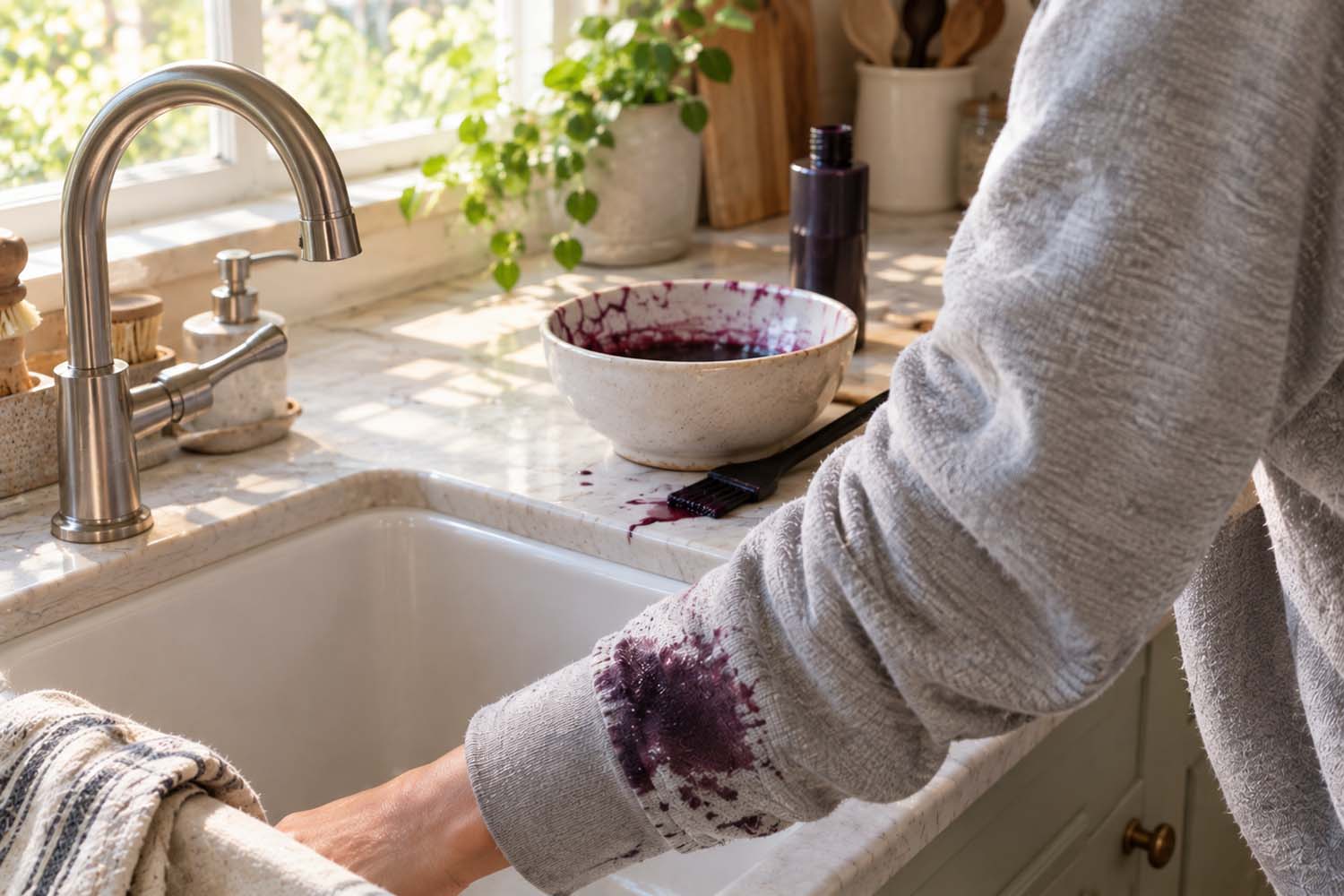
Table of Contents
- Why Hair Dye Isn’t Like Other Stains on This Site
- The Golden Rule: You’re Racing a Chemical Reaction, Not a Stain
- Stain Variants: Permanent, Semi-Permanent, Henna, and Temporary
- Prevent It Before It Happens
- How to Get Hair Dye Out of Clothes: 4 Tested Methods
- By Fabric Type
- Step-by-Step Protocol
- What Doesn’t Work
- The One Thing I Wish I’d Known Sooner
- Final Thoughts
- FAQ
I dyed my hair at my kitchen sink last winter, wearing what I thought was appropriate protection: an old gray sweatshirt I didn’t care about. What I didn’t plan for was leaning over the counter and catching the cuff against a drip of dye that had pooled near the faucet. By the time I noticed, a dark ring had already soaked into the fabric. I assumed the shirt was done for the second I saw it, the same instinct that makes anyone assume a dark stain is automatically a permanent one. It wasn’t, and what actually determined whether that stain came out had less to do with the detergent I reached for and more to do with how many minutes had passed since the dye left the bottle.
The Short Answer: Rinse the stain with cold water immediately, then blot with rubbing alcohol or hairspray while it’s still wet, since alcohol dissolves the dye before it fully develops. Follow with a dish soap treatment, then an overnight oxygen bleach soak for anything that’s dried. Never mix ammonia-based products with bleach. Skip the dryer until the stain is confirmed gone, and treat wool, silk, and nylon with extra urgency, since those fibers grab dye more readily than cotton.
Why Hair Dye Isn’t Like Other Stains on This Site
Most stain guides treat hair dye like a straightforward pigment problem: identify the color, hit it with the right solvent, done. That misses what’s actually happening chemically, and it’s why so many people report a hair dye stain “coming back” faintly after a wash that seemed to work.
Permanent hair dye ships as two components that are almost colorless until they’re mixed. One is the dye precursor cream, carrying ammonia or another alkalizing agent. The other is the developer, usually hydrogen peroxide. The moment they combine, an oxidation reaction begins that keeps running for roughly 20 to 45 minutes, the same rough processing window you’d wait out on your own head, though a stain sitting on fabric at room temperature will generally react a bit slower than dye processing against the warmth of your scalp. During that window, the reaction converts small, soluble dye precursor molecules into large, complex pigment molecules that resist coming back out once they’ve fully formed. This reaction doesn’t require hair specifically to run. It’s already changing color in the mixing bowl before it ever touches a single strand, which is exactly why it keeps going on a shirt cuff too.
The Golden Rule: You’re Racing a Chemical Reaction, Not a Stain
Here’s the piece almost no other guide gets right. A hair dye stain isn’t “set” the moment it touches fabric the way a coffee or wine stain is. If you catch it while the mixed dye is still actively oxidizing, the pigment molecules are still small and soluble, and alcohol, dish soap, or a vinegar rinse can pull them out before they lock in. Once that same 20 to 45 minute reaction finishes, on your shirt exactly the same as on your hair, those molecules have already coupled into large, wash-fast structures that behave like a cured stain rather than a fresh one.
This is also why textile dye chemists formulate an entirely different class of dye for protein-based fibers like wool and silk, and for nylon, than they do for cotton. Fibers with free amine groups grab and hold dye molecules through actual chemical bonds, while cellulose fibers like cotton mostly just trap pigment mechanically. It’s a different mechanism than the reaction happening in the dye itself, but the net effect is the same: wool, silk, and nylon hold on to hair dye more stubbornly than cotton does, so they deserve extra urgency on top of the timing issue.
Stain Variants: Permanent, Semi-Permanent, Henna, and Temporary
Permanent, oxidative dye (most box dyes and salon color): This is the reaction-race scenario above. Speed matters more than anything else you do.
Semi-permanent or direct fashion color (vivid shades like the ones sold for at-home color changes): No developer, no ongoing reaction. The pigment is already fully formed the moment it leaves the tube, so there’s no chemical clock to beat, but the color load is often extremely concentrated, which can make it harder for oxygen bleach to fully lift, even when treated quickly.
Henna and other plant-based dyes: These bind to keratin through their own strong, direct mechanism and are notoriously long-lasting on hair for exactly that reason. On fabric, expect the same stubbornness. Treat henna stains as urgent and don’t expect a single treatment to fully clear it.
Temporary color (hair chalk, root touch-up spray, temporary rinses): These sit on the surface without penetrating or reacting, so a simple cold rinse and regular wash usually clears them without drama.
Darker permanent shades, like black, dark brown, and burgundy, carry a higher concentration of dye precursor than lighter or ashier tones, so a dark-shade stain is genuinely more saturated and slower to fully clear than a light one, not just harder to see progress on.
Prevent It Before It Happens
The easiest hair dye stain to deal with is the one you never get. Drape an old towel or a proper coloring cape over your shoulders before you start, and keep a second towel nearby for your hands and the sink edge, since drips there are what usually end up on a cuff or hem. Wear something you don’t mind ruining rather than reaching for whatever’s clean, and keep the mixed dye bottle capped and upright between applications rather than resting it on its side near fabric.
How to Get Hair Dye Out of Clothes: 4 Tested Methods
1
The Alcohol Flush (fresh, still-wet permanent dye)
If there’s any excess dye still sitting on top of the fabric, scrape it away gently with a dull knife or the edge of a credit card before you add any liquid, so you’re not working more of it into the fibers. Blot, don’t rub, with rubbing alcohol or a spray of alcohol-based hairspray while the dye is still wet. Alcohol dissolves the unreacted dye precursors before the oxidation reaction locks them in place. This only works before the garment has been washed or dried. Once heat or a full wash cycle hits it, this window is closed. Verdict: your single best move if you catch the stain within minutes.
2
Dish Soap and Cool Water (fresh to same-day stains, all dye types)
Rinse the back of the stain under cool running water to push dye out and away from the fibers. Work a few drops of liquid dish soap into the stain with your fingers or a soft cloth, then rinse again. This lifts surface pigment and any oily carriers in the formula. Verdict: a solid second step after the alcohol flush, and a reasonable first step if alcohol isn’t on hand.
3
The Vinegar Rinse (mid-stage stains, still within the processing window)
Soak a cloth in white vinegar and blot the stain, letting it sit for about 15 minutes before rinsing. Vinegar’s acidity works against the alkaline environment the oxidation reaction needs to keep running, which may help slow it down if you’re still within that same 20 to 45 minute window. Don’t combine this step with ammonia-based products. Verdict: most useful as a bridge treatment when you can’t get to alcohol or a wash right away.
4
The Overnight Oxygen Bleach Soak (dried or fully set stains)
Mix an oxygen bleach powder according to package directions in cool water and soak the stained area for at least 8 hours or overnight. This is your best shot once the dye has fully oxidized and set. An oxygen bleach powder handles this without the fiber damage or unpredictable color reactions chlorine bleach can cause. Verdict: the step that saves garments other methods couldn’t fully clear.
Pro tip: Keep an enzyme-based stain remover on hand for hair dye that’s mixed with conditioner or oil-based treatments, since the enzyme formula breaks down the protein and fat components a straight bleach soak won’t touch on its own. A stain remover pen is also worth keeping in a bathroom drawer for the same reason you’d want one for a self-tanner mishap. Speaking of which, if you’re dealing with both in the same getting-ready routine, our self-tanner stain guide covers a similar race-against-a-reaction chemistry.
By Fabric Type
White cotton: The most forgiving option. Dish soap followed by an oxygen bleach soak clears most stains, and white cotton tolerates a longer soak than colored pieces.
Colored cotton: Same approach, but patch test the oxygen bleach on an inside seam first to confirm colorfastness.
Linen: Treat quickly with the alcohol flush and dish soap. Limit any oxygen bleach soak to one to two hours rather than overnight, since linen’s high alkalinity sensitivity means extended soaking can yellow the flax fibers over time.
Polyester and synthetic activewear: Dish soap and a short oxygen bleach soak generally lift the stain well, since synthetic fibers don’t hold dye the way protein and polyamide fibers do.
Silk: Treat as urgent. Alcohol flush immediately if the stain is fresh, then a gentle dish soap blot, never a scrub. A professional cleaner is a safer bet than repeated home treatment on anything valuable.
Wool: Same urgency as silk. Cold water only, gentle blotting, and avoid wringing or twisting the fibers while wet.
Nylon: Treat with real urgency here too. Nylon shares the same class of dye-reactive amine groups that make wool and silk hold color so well, which means it can grip hair dye more stubbornly than a plain polyester blend would.
Dry-clean-only fabrics: Blot gently with a cool, damp cloth to keep the stain from spreading, then get it to a professional as soon as possible and point out both the stain and roughly how long it’s been since the dye was applied.
Step-by-Step Protocol
- Note how long ago the dye was mixed. This matters more than almost anything else you’ll do.
- Gently scrape away any excess dye sitting on the surface before adding any liquid.
- Rinse the back of the stain under cool running water immediately.
- If the stain is still wet and you’re within the processing window, blot with rubbing alcohol or hairspray.
- Work in liquid dish soap and rinse again with cool water.
- Check the stain in good light. If color remains, move to an oxygen bleach soak rather than repeating the same step.
- Soak in an oxygen bleach solution for at least 8 hours, longer for stubborn or fully set stains on sturdy fabrics.
- For dye mixed with conditioner or oil treatments, follow with an enzyme stain remover pretreatment before the final wash.
- Wash according to the care label, using the warmest water the fabric safely allows.
- Inspect again before drying. Any remaining shadow means the stain isn’t gone, and the dryer will lock in what’s left.
Never do this:
- Never mix ammonia-based stain treatments with chlorine bleach. The combination produces toxic fumes and is a genuine safety hazard, not just a fabric-care mistake.
- Never combine vinegar and ammonia in the same treatment. They neutralize each other and waste both products.
- Never put the garment in the dryer until you’ve confirmed the stain is fully gone. Heat locks the pigment in permanently.
- Never use chlorine bleach on colored garments. Reserve it for white, sturdy fabrics only, and never soak longer than about 15 minutes.
- Never scrub a set stain in circles. This spreads the pigment and can damage silk or wool fibers.
- Never assume the hairspray trick will work once the garment has already been washed or dried. It only works on an untreated, still-fresh stain.
What Doesn’t Work
Reaching for a generic stain stick alone and expecting it to fully clear a fully set, oxidized hair dye stain often falls short, since the pigment molecules by that point are the same large, wash-fast structures that make the color so durable on hair in the first place. A stain stick helps as pretreatment, but it isn’t a substitute for the oxygen bleach soak once the dye has finished reacting.
See also

Toothpaste shows up in a few home-remedy roundups for hair dye, and it can occasionally help lift fresh dye from white cotton, but most formulas contain mild abrasives and whitening agents that aren’t built for fabric and can bleach colored garments. Treat it as a last resort on white cotton only.
Assuming a vivid semi-permanent fashion color will respond exactly like a natural-toned permanent dye is a common mistake. Since there’s no oxidation reaction to interrupt, speed still helps, but expect the color load itself, not the chemistry, to be the harder obstacle.
The One Thing I Wish I’d Known Sooner
I spent that first afternoon assuming the sweatshirt cuff was a lost cause because the stain looked dark and immediate. It wasn’t the darkness that mattered. It was that I still had time left in that 20 to 45 minute window before the dye finished its own reaction. Once I understood that the clock belonged to the chemistry and not to how the stain looked, I stopped panicking over how a fresh stain appeared and started paying attention to how many minutes I actually had.
Final Thoughts
Hair dye looks alarming the moment it hits fabric, but the real question isn’t how dark the stain looks. It’s how much of the dye’s own processing window is still left. Move fast with alcohol and dish soap, follow with an oxygen bleach soak for anything that’s already set, and give wool, silk, and nylon extra urgency. If you’re dealing with a similar bathroom mishap, our guides on self-tanner stains and ink stains cover related chemistry.
FAQ
Does hair dye stain come out of clothes? Yes, especially if treated within the same processing window the dye needs to develop on hair, roughly 20 to 45 minutes. After that, an oxygen bleach soak is your best remaining option.
How long do you have before a hair dye stain sets permanently? Roughly the same processing time listed on the box, since the dye’s oxidation reaction runs on its own clock regardless of what surface it’s on.
Will hydrogen peroxide remove hair dye from clothes? Peroxide-based oxygen bleach can help lift set stains, but straight hydrogen peroxide can act as a mild bleach on colored fabric, so test on a hidden area first.
Does hairspray really remove hair dye stains? Yes, but only on a fresh, unwashed stain. The alcohol in hairspray dissolves unreacted dye before it locks in. It won’t do anything for a stain that’s already been through a wash or dry cycle.
Can you get henna out of clothes? It’s difficult. Henna bonds to keratin through its own strong, direct mechanism, and it behaves the same way on fabric. Treat it immediately and don’t expect full removal in one pass.
Is it safe to mix bleach with ammonia-based stain removers? No. This produces toxic fumes and should never be attempted, regardless of how stubborn the stain is.
Does hair dye stain synthetic fabric like polyester less than cotton? Generally yes. Polyester lacks the reactive amine groups that make wool, silk, and nylon grab dye so readily, so it tends to release hair dye more easily than those fibers do.
Can a dry cleaner remove hair dye stains? Often, especially on delicate or dry-clean-only fabrics. Point out the stain and how long it’s been since the dye was applied, since that timing affects their approach too.
How do you get hair dye off carpet? Scrape away any excess first, then blot (don’t rub) with a mix of cool water, a little dish soap, and a splash of white vinegar, working from the outer edge of the stain inward. Test any solution on a hidden corner first.
Related Stain Guides:

Better Living may earn commissions through affiliate links and may occasionally feature sponsored or partner content. If you make a purchase through our links, we may receive a small commission at no cost to you.
Originally published by onbetterliving.com. Syndicated material does not necessarily reflect the views of Glamour Canada.